After a 6-month haitus, I am finally writing another post. Rummaging through my dad's office, I found one of my great-grandfather David Lester McBride's old priesthood manuals, A Seventy's Course in Theology. The Seventy's Course was a series of priesthood manuals authored by B. H. Roberts and originally used by, you guessed it, Seventies Quorums, between 1907 and 1911. The book in my dad's credenza consisted of volumes 1 and 2, bound together.
I have long been familiar with these manuals; even read lengthy passages. In fact, I'll admit I envy somewhat the brethren who used this course for their lessons. The subject matter is often intriguing, with lesson titles such as "The Inexorableness of Law" and "Patristic Notions of God." But it was not the content of the manuals that caught my attention yesterday.
David Lester wrote his name inside the back cover, along with the following address: "287 Bainbridge St. Brooklyn." We knew great-grandpa was serving a mission to New York at that time. Now we know where he lived for at least part of the time. Here is a Google Maps satellite view:
View Larger Map
There appears to be a building there that may have been his apartment building, though it is difficult to be sure. Here is a Google Street View shot:
View Larger Map
Need to do a little more research on this on. If I remember correctly, the newspaper report of his funeral included a short account of a talk given by one of his companions. I'll have to dig that out. Also, we have a photo of him with his companion taken during his mission. Need to post that, too.
Sunday, October 31, 2010

Sunday, April 18, 2010
More photographs of Mullenark


Here are some nice, medium resolution photos of Mullenark Castle I found the other day. The first one is of the front of the building. Nothing new, but kind of a nice shot.
The second is interesting because it shows one of the front towers at the vantage from which grandpa's fellow platoon members would have seen them. Fairly imposing, when you consider, as Frank Perozzi said, there were snipers firing at them from the turrets as they dug their fox holes.
The third photo is of the mill house just to the southeast of the house. The moat ran right along this structure and it was positioned near the mill pond, too.
The last photo is of one of the walls surrounding the estate. These were the walls grandpa spoke of using to skirt the property and make their way into Schophoven to the northwest. According to the photo's description (as "translated" by Google), the damage to the wall was sustained during World War II. It's conceivable that the scars were inflicted by the artillery preparation that preceded the infantry assault on Mullenark the night of December 13, 1944.
Wednesday, March 31, 2010
David Lester McBride's Draft Card
David Lester McBride and Annie Leishman Brown McBride were married 18 January 1911, the outset of a turbulent decade. Neta was born late that same year, Reba joined the family early in 1913 and Annie Ruth was born in 1915.
Direct U.S. military involvement in World War I began on 6 April 1917 after three years of stubborn isolationism. Initially only 32,000 men volunteered. The commitment to send a large U.S. force to Europe led to the passage of the Selective Service Act. Under its mandate, three draft lotteries were held during the next 18 months. The first, which was held on 5 June 1917, required that eligible men born between 1886 and 1896 (ages 20-30) register for the draft. The second was one year later to the day, for those who had turned 20 during the previous 12 months. Of the combined 11 million men who registered for these two lotteries, almost 2 million were actually drafted. Unfortunately, this was not enough.
At the request of the War Department, Congress amended the Selective Service Act in August 1918 to expand the age range to include all men 18 to 45. Suddenly 36-year-old father of 4, David Lester McBride, was draft eligible. He was to report to the Cache County draft board on September 12 to register for the third draft lottery.
The previous January, David and Annie had welcomed their first son into the family, Ward Lester. Ward was only 7 months old at the time of the draft lottery. I can only imagine the anxiety David and Annie experienced when they heard about the draft. He reported that day and filled out his draft registration card. Here is the card:


Direct U.S. military involvement in World War I began on 6 April 1917 after three years of stubborn isolationism. Initially only 32,000 men volunteered. The commitment to send a large U.S. force to Europe led to the passage of the Selective Service Act. Under its mandate, three draft lotteries were held during the next 18 months. The first, which was held on 5 June 1917, required that eligible men born between 1886 and 1896 (ages 20-30) register for the draft. The second was one year later to the day, for those who had turned 20 during the previous 12 months. Of the combined 11 million men who registered for these two lotteries, almost 2 million were actually drafted. Unfortunately, this was not enough.
At the request of the War Department, Congress amended the Selective Service Act in August 1918 to expand the age range to include all men 18 to 45. Suddenly 36-year-old father of 4, David Lester McBride, was draft eligible. He was to report to the Cache County draft board on September 12 to register for the third draft lottery.
The previous January, David and Annie had welcomed their first son into the family, Ward Lester. Ward was only 7 months old at the time of the draft lottery. I can only imagine the anxiety David and Annie experienced when they heard about the draft. He reported that day and filled out his draft registration card. Here is the card:


While in good health and otherwise eligible, David was not selected. Thankfully, he was allowed to remain home to care and provide for his growing family. They experienced war on the home front. One inventory of typical wartime activities experienced by many Utahns included planting "victory gardens," preserving food, volunteering for work in the beet fields and on Utah's fruit farms, purchasing Liberty Bonds, giving "Four Minute" patriotic speeches, collecting money for the Red Cross, using meat and sugar substitutes, observing meatless days, knitting socks, afghans, and shoulder wraps, weaving rugs for soldiers' hospitals, making posters, prohibiting the teaching of the German language in some schools, and cultivating patriotism at every opportunity.
During these same trying years (1917-1920), an influenza pandemic swept the nation killing an estimated 600,000 Americans. In 1920, the deadly virus claimed the lives of 5-year-old Annie Ruth and 2-year-old Ward Lester. Neta recalled: "When the little kids died, I [was] 7. I can remember when they carried those little things out, and how everyone was so sick.... Mother, seems like that all she did was cry.... She couldn’t get over those kids dying... They’d done something out there on that porch and she wouldn’t ever let us paint over it because she says that was the last finger prints... she’d ever see."
Annie, already prone to anxiety and depression, would never fully recover from this terrible blow. She died in the Utah State Hospital in Provo on 27 October 1932. But that is a subject for another day.
Annie, already prone to anxiety and depression, would never fully recover from this terrible blow. She died in the Utah State Hospital in Provo on 27 October 1932. But that is a subject for another day.
Monday, March 22, 2010
Group Photo at Place de la Concorde in Paris
Once the Timberwolves reached Cologne, their advance halted for a few weeks. At the time, Cologne was Germany's third largest city. It stood on the west bank of the Rhine River, the last natural barrier between the Allies and what they anticipated would be a dagger to the heart of Germany: an attack on the industrial Ruhr region. Lee's battalion captured the small town of Efferen on the approaches to Cologne early in February 1945, then moved into a residential area in the southern part of Cologne on 8 February. While most of the division underwent a rigorous training routine and practiced river crossings in nearby lakes, Grandpa Lee took a trip to Paris. His account of this time reads:
"At this time there became available a number of 3-day passes to Paris. It seemed an opportunity worth accepting and so together with some 50 or so others it was back away from the front to France. It was cold and gray the whole time we were in Paris but it was also interesting to see the many sights—the Eiffel Tower, Arc de Triumph, Cathedral of Notre Dame, Louvre etc. We had a group photo taken at the Place de la Concorde near the Arc de Triumph at the head of the Champs de Elysees."
Here is the photo (courtesy of Marilyn Hansen). Grandpa is the 7th from the right on the front row:

Here is a photo my kids and I took recently at the same fountain. Not much has changed since 1945:

Lee continued: "While 'enjoying' the sights of Paris we received word that a bridge across the Rhine had been captured intact. All passes were cancelled and it was back to Cologne on the first train." This of course was the bridge at Remagen. Upon his return, he joined his battalion in an assembly area near Bad Honnef (a few miles north of Remagen) and on Feb. 23 they crossed the Rhine on pontoon bridges. They were riding the trucks and tanks of the 3rd Armored Division. A fellow member of the 414th described the crossing: "The pontoon bridge over the Rhine was a carnival ride. The pontoon you were on was down in the water, the one in front of you was about 3 or 4 feet above you, and the one behind popped up as soon as you drove off of it."
"At this time there became available a number of 3-day passes to Paris. It seemed an opportunity worth accepting and so together with some 50 or so others it was back away from the front to France. It was cold and gray the whole time we were in Paris but it was also interesting to see the many sights—the Eiffel Tower, Arc de Triumph, Cathedral of Notre Dame, Louvre etc. We had a group photo taken at the Place de la Concorde near the Arc de Triumph at the head of the Champs de Elysees."
Here is the photo (courtesy of Marilyn Hansen). Grandpa is the 7th from the right on the front row:

Here is a photo my kids and I took recently at the same fountain. Not much has changed since 1945:

Lee continued: "While 'enjoying' the sights of Paris we received word that a bridge across the Rhine had been captured intact. All passes were cancelled and it was back to Cologne on the first train." This of course was the bridge at Remagen. Upon his return, he joined his battalion in an assembly area near Bad Honnef (a few miles north of Remagen) and on Feb. 23 they crossed the Rhine on pontoon bridges. They were riding the trucks and tanks of the 3rd Armored Division. A fellow member of the 414th described the crossing: "The pontoon bridge over the Rhine was a carnival ride. The pontoon you were on was down in the water, the one in front of you was about 3 or 4 feet above you, and the one behind popped up as soon as you drove off of it."
Friday, March 19, 2010
Battle for Raguhn
The battle of Raguhn was where Lee earned his Silver Star. It is one of the few experiences of which he gives a detailed account. In addition to his account, we have his citation, and a retelling of the battle from the perspective of another Timberwolf, William Bracey, who also participated in the battle. I've done my best to reconstruct the events using these and a few other sources.
Raguhn sits astride the Mulde River, which splits in two channels at Raguhn, creating a substantial island in the center of the town. The portion of the town to the west of the river channels had been taken the previous day by a coordinated air-armor-infantry attack in which another company of 2nd Battalion 414th Regiment had participated. F Company "entered the city late in the afternoon and found a small tank repair crew with two partially disabled tanks already there." The Battalion CO, Maj. John Melhop ordered F Company to remain in Raguhn the evening of the 16th while some of the other units continued their mopping up of the area.
According to fellow platoon member Tom Lacek, the strength of F Company was about thirty men, down from a full complement of 180. Lee’s platoon had fared better than some—there were still about nine platoon members—but they were feeling decimated. At the time, 2nd Battalion was still attached to the 3rd Armored Division, and had been riding tanks from town to town in coordinated combat. They found a house near the railroad tracks, that run north-south parallel to the river on the western of side Raguhn and settled in for what they hoped would be a peaceful night.
They were in for a rude awakening. They were notified by the Battalion that intelligence indicated a German counterattack in the making. Raguhn and nearby towns Thurland (six miles to the west) and Siebenhausen, (about five miles south) were the focus of the counterattack late that night. The 2nd Battalion CP in Thurland was completely overrun, and the troops quartered in Raguhn were almost completely surrounded.
William Bracey of H Company (the only other company in town) was among the first who was aware that the attack had reached them. He heard shouting in German outside his door at No. 4 Markesche Strasse, on the western outskirts of town at about 3:00 the morning of the 17th. He reported that about “about 50 German infantrymen came by the doorway, in single file, close enough that I could have reached out and touched them.” He and his comrades were not detected because they had parked their Jeeps and half-track on the north and south sides of No. 4 behind high fences.
The map below shows the location of No. 4 in Raguhn, just east of the railway. Further to the east, you'll see the several branches of the Mulde:
Word of the counterattack quickly reached the F Company men. As Lee put it: “Much to our chagrin we awakened in the morning to find ourselves, one infantry platoon plus the tank mechanics, surrounded by the enemy—cut off from our support.”
Lee’s “platoon leader at the time was unable to function due to battle fatigue.” As Assistant Platoon leader, Tech Sgt. McBride assumed command of the platoon. “We made [the Platoon leader] comfortable in a basement and went out to see what needed doing.” As a later citation recorded: “[Lee] voluntarily left his covered position and assumed command of a platoon which was attempting to dislodge the enemy from his newly won positions. After a fierce fight, during which he constantly exposed himself to withering enemy fire, Sergeant McBride’s men were surrounded by the superior enemy force.” Lee put it more modestly: “It was routine work clearing the enemy from all of the buildings in town with the exception of a large factory.”
It is apparent that this house-to-house fighting, though routine, was no walk in the park. Tom Lacek recalled that they were “up all night,” repelling the German counterattack. Bracey observing the action from the windows of his house added, “Our F Company riflemen soon engaged the Germans, forcing them into a factory, and house across the street from the factory.”
The factory was “a brick building of one story located at the extreme edge of town adjacent to open fields. The enemy command post was located in this building and the German troops were ‘dug in’ in the fields surrounding the town.” It was apparently very close to the house on Markesche Strasse.
Since an infantry attack on the factory would have a been a dangerous and costly endeavor, the F Company doughs decided to “bring one of the tanks down to the building as a persuasive force.” The tanks were several blocks from the factory, just east of the railroad tracks. McBride contacted the tank mechanics, who “were very reluctant to get involved but finally agreed to bring the better of the two tanks along and see if it could be of help.” He then “courageously ran a gauntlet of enemy fire to lead [the] tank forward.” According to his account, the then “positioned the tank close to a window of the building and placed the muzzle of the cannon directly facing the window. Fortunately there was nothing wrong with that part of the tank and we sent a round into the building. The shrapnel ricocheting about the inside of that building must have been somewhat disconcerting to the German officers inside. Another invitation to surrender was tendered. This time they offered to leave the town and take all their people from the fields about the town with them.”
Bracey, after attempting unsuccessfully to help clear the Germans from the house across from the factory, returned to No. 4 and watched the situation unfold: “Our tank moved into position to fire on the factory and house. At this point, a white flag appeared, and through an interpreter, the Germans asked for safe passage through our line to their positions on the island and east bank of the Mulde River.” According to Bracey's account, Lee, who was directing the fire of the tanks, replied: “What the hell do they think we are playing—checkers? Tell them to surrender or we’ll blow up the factory and them with it!”
Lee’s continues humorously: “We refused their generous offer and presented them with another round or two of fire from the big gun on the tank. After the reverberations died down we again invited them and all their men from the surrounding fields to join us with hands behind their heads. This time they agreed that might be a good idea after all and proceeded to line up the entire unit in the courtyard” across the street from the factory to the north.
They “sent to the basement room where we had left our platoon leader and had him come to accept the surrender of over a hundred German troops.” Lee noted: “You see, I was leading the platoon [but] as a non-commissioned officer was not worthy to accept the surrender of the German officers and their men.” Lee was awarded a Silver Star for this action, which he insisted, “should have gone to the platoon, not the Platoon Sergeant.” Here is the citation in full:

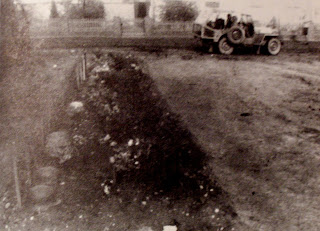
After the counterattack was squelched Major Melhop returned in a jeep to Raguhn where he found things under control thanks to the quick thinking and dash of those few remaining F Company members. Melhop took pictures of the large number of German bodies that had been placed in open graves victims of the house-to-house fight. The following is one of those pictures:
Raguhn sits astride the Mulde River, which splits in two channels at Raguhn, creating a substantial island in the center of the town. The portion of the town to the west of the river channels had been taken the previous day by a coordinated air-armor-infantry attack in which another company of 2nd Battalion 414th Regiment had participated. F Company "entered the city late in the afternoon and found a small tank repair crew with two partially disabled tanks already there." The Battalion CO, Maj. John Melhop ordered F Company to remain in Raguhn the evening of the 16th while some of the other units continued their mopping up of the area.
According to fellow platoon member Tom Lacek, the strength of F Company was about thirty men, down from a full complement of 180. Lee’s platoon had fared better than some—there were still about nine platoon members—but they were feeling decimated. At the time, 2nd Battalion was still attached to the 3rd Armored Division, and had been riding tanks from town to town in coordinated combat. They found a house near the railroad tracks, that run north-south parallel to the river on the western of side Raguhn and settled in for what they hoped would be a peaceful night.
They were in for a rude awakening. They were notified by the Battalion that intelligence indicated a German counterattack in the making. Raguhn and nearby towns Thurland (six miles to the west) and Siebenhausen, (about five miles south) were the focus of the counterattack late that night. The 2nd Battalion CP in Thurland was completely overrun, and the troops quartered in Raguhn were almost completely surrounded.
William Bracey of H Company (the only other company in town) was among the first who was aware that the attack had reached them. He heard shouting in German outside his door at No. 4 Markesche Strasse, on the western outskirts of town at about 3:00 the morning of the 17th. He reported that about “about 50 German infantrymen came by the doorway, in single file, close enough that I could have reached out and touched them.” He and his comrades were not detected because they had parked their Jeeps and half-track on the north and south sides of No. 4 behind high fences.
The map below shows the location of No. 4 in Raguhn, just east of the railway. Further to the east, you'll see the several branches of the Mulde:
Lee’s “platoon leader at the time was unable to function due to battle fatigue.” As Assistant Platoon leader, Tech Sgt. McBride assumed command of the platoon. “We made [the Platoon leader] comfortable in a basement and went out to see what needed doing.” As a later citation recorded: “[Lee] voluntarily left his covered position and assumed command of a platoon which was attempting to dislodge the enemy from his newly won positions. After a fierce fight, during which he constantly exposed himself to withering enemy fire, Sergeant McBride’s men were surrounded by the superior enemy force.” Lee put it more modestly: “It was routine work clearing the enemy from all of the buildings in town with the exception of a large factory.”
It is apparent that this house-to-house fighting, though routine, was no walk in the park. Tom Lacek recalled that they were “up all night,” repelling the German counterattack. Bracey observing the action from the windows of his house added, “Our F Company riflemen soon engaged the Germans, forcing them into a factory, and house across the street from the factory.”
The factory was “a brick building of one story located at the extreme edge of town adjacent to open fields. The enemy command post was located in this building and the German troops were ‘dug in’ in the fields surrounding the town.” It was apparently very close to the house on Markesche Strasse.
Since an infantry attack on the factory would have a been a dangerous and costly endeavor, the F Company doughs decided to “bring one of the tanks down to the building as a persuasive force.” The tanks were several blocks from the factory, just east of the railroad tracks. McBride contacted the tank mechanics, who “were very reluctant to get involved but finally agreed to bring the better of the two tanks along and see if it could be of help.” He then “courageously ran a gauntlet of enemy fire to lead [the] tank forward.” According to his account, the then “positioned the tank close to a window of the building and placed the muzzle of the cannon directly facing the window. Fortunately there was nothing wrong with that part of the tank and we sent a round into the building. The shrapnel ricocheting about the inside of that building must have been somewhat disconcerting to the German officers inside. Another invitation to surrender was tendered. This time they offered to leave the town and take all their people from the fields about the town with them.”
Bracey, after attempting unsuccessfully to help clear the Germans from the house across from the factory, returned to No. 4 and watched the situation unfold: “Our tank moved into position to fire on the factory and house. At this point, a white flag appeared, and through an interpreter, the Germans asked for safe passage through our line to their positions on the island and east bank of the Mulde River.” According to Bracey's account, Lee, who was directing the fire of the tanks, replied: “What the hell do they think we are playing—checkers? Tell them to surrender or we’ll blow up the factory and them with it!”
Lee’s continues humorously: “We refused their generous offer and presented them with another round or two of fire from the big gun on the tank. After the reverberations died down we again invited them and all their men from the surrounding fields to join us with hands behind their heads. This time they agreed that might be a good idea after all and proceeded to line up the entire unit in the courtyard” across the street from the factory to the north.
They “sent to the basement room where we had left our platoon leader and had him come to accept the surrender of over a hundred German troops.” Lee noted: “You see, I was leading the platoon [but] as a non-commissioned officer was not worthy to accept the surrender of the German officers and their men.” Lee was awarded a Silver Star for this action, which he insisted, “should have gone to the platoon, not the Platoon Sergeant.” Here is the citation in full:

After the counterattack was squelched Major Melhop returned in a jeep to Raguhn where he found things under control thanks to the quick thinking and dash of those few remaining F Company members. Melhop took pictures of the large number of German bodies that had been placed in open graves victims of the house-to-house fight. The following is one of those pictures:

Sunday, March 14, 2010
Sons of the Servants of St. Bridget
The McBride's were an early Scottish clan. Many of these clans looked to a patron saint as a source of unity. Our clan adopted St. Bridget as their patron. Who was St. Bridget? Bridget was a famous Abbess of Kildare, Ireland. She died in 525 A.D. This is the entry on St. Bridget in the Catholic Encyclopedia:
Dictionaries of patronymic names suggest that the following additional names are all variations on this theme: Mac Bride, St. Bridget, McBrides, Mac Brides, Mc Bryde, Bride, Brides, Bridget, Bridgets, Bryget, Bryde and Brydes, Mac Kilbride, Killbride, Bridie, Brydie, Bridey, and McBryd. The McBride name in its current formulation (if not exact spelling--"McBryd") originated in 1329 in Scotland.
St. Bridget arrived in Ireland a few years after St. Patrick. Her father was an Irish lord named Duptace. As Bridget grew up, she became holier and more pious each day. She loved the poor and would often bring food and clothing to them. One day she gave away a whole pail of milk, and then began to worry about what her mother would say. She prayed to the Lord to make up for what she had given away. When she got home, her pail was full! Bridget was a very pretty young girl, and her father thought that it was time for her to marry. She, however, had given herself entirely to God when she was very small, and she would not think of marrying anyone. When she learned that her beauty was the reason for the attentions of so many young men, she prayed fervently to God to take it from her. She wanted to belong to Him alone. God granted her prayer. Seeing that his daughter was no longer pretty, her father gladly agreed when Bridget asked to become a Nun. She became the first Religious in Ireland and founded a convent so that other young girls might become Nuns. When she consecrated herself to God, a miracle happened. She became very beautiful again! Bridget made people think of the Blessed Mother because she was so pure and sweet, so lovely and gentle. They called her the "Mary of the Irish."A story, I'm sure, that loses nothing in the telling. The clan was so zealous in their devotion to St. Bridget that it came to define them. They were known as the Gillebride, in other words "Servants of Bridget" or "Followers of Saint Bridget," "gille" being a Gaelic word for "servant," and "bride" a contracted form of "Bridget." Clan surnames like this (with the word "servant" or "devotee" followed by the name of a saint) were fairly common. Their descendants were often known as Macgillbride (or the Irish equivalent "Mac Giolla Bhride"), or "Sons of the Followers of Bridget," and eventually McBride. I imagine the the celibate Bridget might have rankled at the idea of this group calling themselves "Sons of Bridget." Libelous!
Dictionaries of patronymic names suggest that the following additional names are all variations on this theme: Mac Bride, St. Bridget, McBrides, Mac Brides, Mc Bryde, Bride, Brides, Bridget, Bridgets, Bryget, Bryde and Brydes, Mac Kilbride, Killbride, Bridie, Brydie, Bridey, and McBryd. The McBride name in its current formulation (if not exact spelling--"McBryd") originated in 1329 in Scotland.
Friday, March 12, 2010
More on Müllenark
The word “Müllenark” in middle-high-German meant “mill dam.” The Müllenark estate was the location of a large mill, and the barons who lived there were known by the name Müllenark as early as the 12th century. The mill was operated by water diverted from the Roer River and retained in a mill pond just to the southeast of the house. The pond and moat mentioned in the various accounts of the battle were respectively the mill pond and the canal that diverted the river water to the mill works. Over the centuries, the Müllenark gristmill was used to grind grain, extract oils, and later to power saws, grinders and other machinery. At its peak, it boasted three large water wheels and serviced several towns in the area, including Schophoven. The mill works were located, in part, in the southern wing of the house, while the northern and western portions of the structure were residential. Most of the machinery operated by the mill in the early 20th century was located in the house located at the southwest corner of the great house. It is possible that the large cellar behind the house was originally used as cold storage for mill products such as flour and oil.
Just for fun, here is Lee's Bronze Star Citation earned at Müllenark on Dec. 13, 1944:

Subscribe to:
Posts (Atom)